Your website is the front end of your own CRM.
The boat dealer website builder inside your CRM. New and used boats, trailers and outboards on a site that refreshes from your inventory and drops every inquiry straight onto a lead, already labeled with its source.
One site, one system behind it.
Think of the boat dealer website builder as a view of your inventory, not a separate site to maintain. The site reads the same inventory records your team edits, so a price change or a sold boat shows up without anyone retyping it. Around 40 kinds of form, plus chat, calls and rep business cards, all land in one lead pipeline with spam checks and source tags. Search markup, local pages and feeds for AI assistants are part of the build, not an add-on.
- Inventory filters, gallery, compare up to three boats, price-drop and trailer-included ribbons, printable spec sheet
- Brand, boat-type and model pages that stay up when a unit sells, with in-stock boats listed under each model
- One page per store with hours, map and departments
- Rep business cards at your-domain/rep-name with a QR code and vCard; leads from a card go to that rep
- Structured data, segmented sitemaps, a redirect map for the old site, and llms.txt plus inventory feeds so AI assistants can read and cite the site
- Renders correctly in phone dark mode and inside the Facebook and Gmail in-app browsers
How the site and the CRM stay connected
- 01
Inventory drives the pages
A boat entered once appears on the site, in feeds and in the CRM. Sold or removed units drop off the grids; model pages stay.
- 02
Every inquiry becomes a lead
Forms, the chat widget, tracked calls and rep cards create or update a lead, dedupe by email, cookie or phone, and tag the source and how they reached out.
- 03
Anonymous browsing gets a name
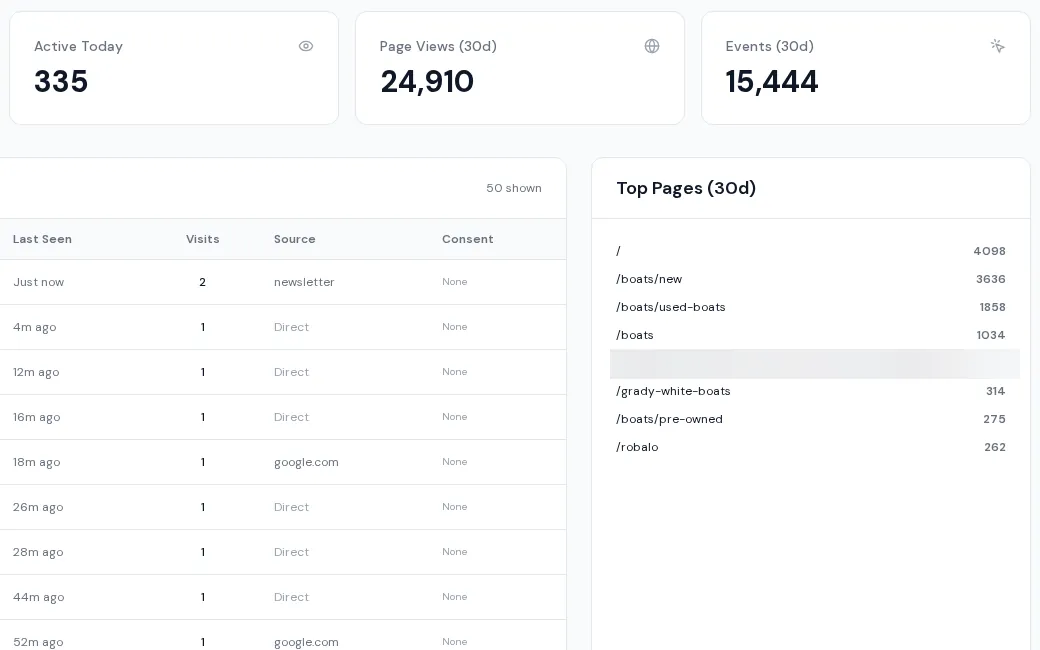
Once a visitor identifies themselves, the pages they viewed earlier attach to their lead, so the rep sees what they looked at before calling.
- 04
Staff edit the site from the admin
Dealer name, phones, locations, hours, brands and popups are settings. Blog posts, landing pages and promotions publish from the same admin.
What to know before you commit
Some pages are hand-written for one dealership
The brand catalog, boat-type hubs, service pages, guides and location copy were written for one dealership. Another dealer gets a build phase to replace them; it is not a settings switch.
Spanish covers 13 key pages
Those pages have Spanish URLs and metadata. Inventory pages are English.
Reviews and saved-search alerts are not finished
A Google rating badge shows on the site. The per-model review block is built but not mounted, and shoppers cannot yet get an alert when a new match arrives.
No online payments or credit application
The site takes deposits and financing inquiries as leads. There is no payment processor and no lender integration.
What dealers ask about this
Yes. Every top Google address from the old site was checked after the move and still opens a working page.
It replaces a separate website vendor and inventory typed into the site by hand, and gives you a site that feeds the CRM.
Identity such as name, phones, locations, brands and logos is editable in settings. Page copy, the brand catalog and the color palette still need build work for a new dealer.